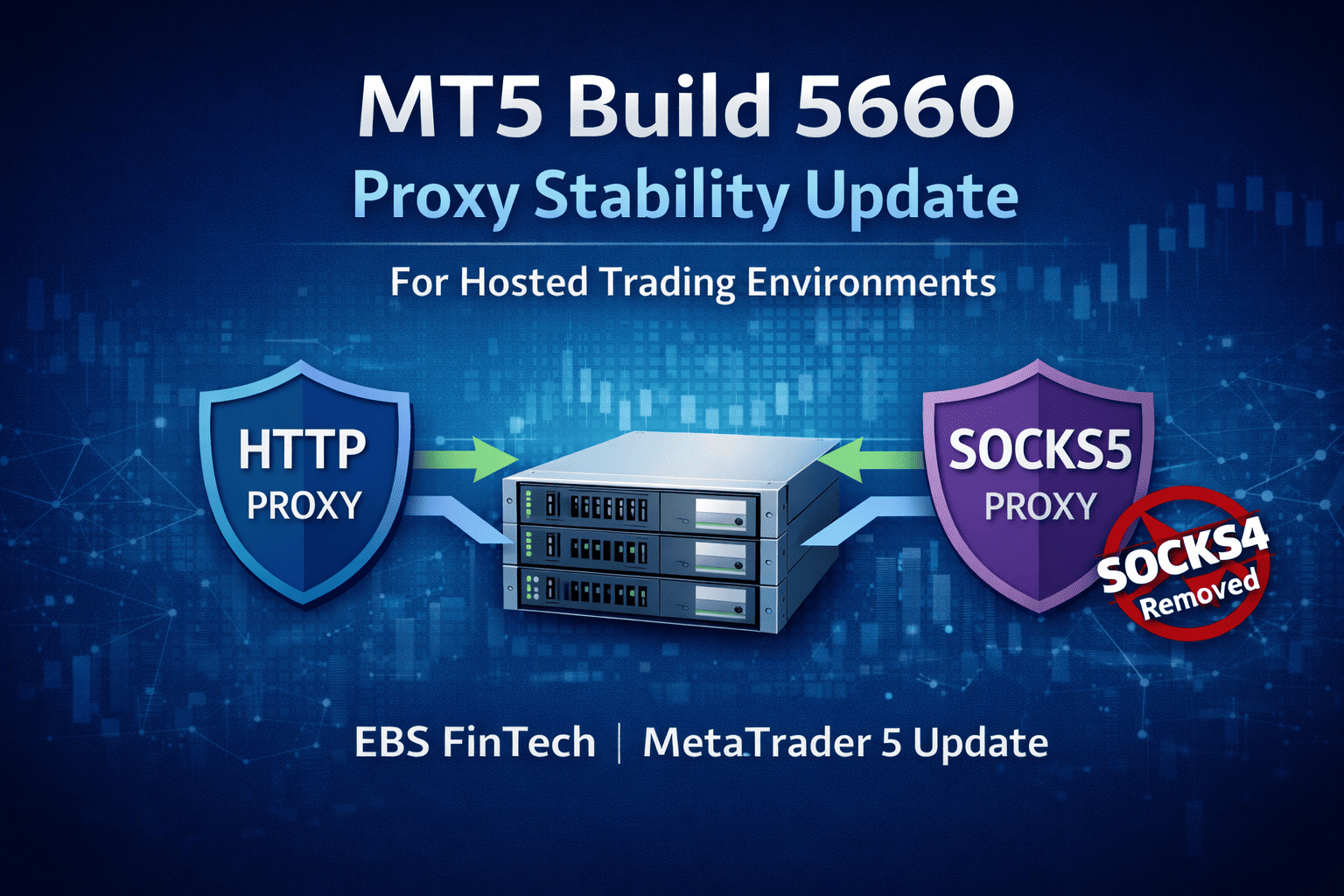
MetaQuotes released MetaTrader 5 Build 5660 on February 27, 2026. According to the official release notes, the update improves support for HTTP and SOCKS5 proxy protocols in order to reduce connection errors, removes support for SOCKS4, and changes the delivery of OpenBLAS into a separate openblas.dll file. At first glance, this may look like a relatively narrow technical update. In practice, however, it touches one of the most important and least visible parts of a production trading environment: the quality of the connection path between users and the platform.
For brokers and trading firms, platform stability is often discussed in terms of server specifications, data center location, or hardware allocation. Those factors matter, but they do not explain every operational issue. In real MT5 deployments, especially those involving hosted infrastructure, multiple regions, enterprise networks, or controlled access environments, reliability is also shaped by routing behaviour, proxy handling, firewall policy, and the consistency of the surrounding infrastructure.
That is why Build 5660 deserves more attention than a routine release note would normally receive. By focusing on proxy server operations rather than visible front end changes, MetaQuotes is effectively acknowledging that connection related friction remains a practical issue in live environments. The wording of the release is direct: HTTP and SOCKS5 support has been enhanced to reduce connection errors, while SOCKS4 is no longer supported. That is not a cosmetic refinement. It is a platform level response to a real infrastructure problem.
From an operational perspective, the improvement to HTTP and SOCKS5 support matters because many connection problems do not present themselves clearly. Users rarely report that a proxy path is unstable. They report repeated login failures, delayed reconnections, intermittent disconnections, or sessions that behave differently across regions. For infrastructure teams, these symptoms can be difficult to isolate because the source may sit somewhere between the terminal, the network path, and the hosted server environment. Better proxy handling at the platform level does not solve every connectivity issue, but it can reduce one important category of failure.
The removal of SOCKS4 support may be even more consequential than the proxy enhancements themselves. In production environments, outdated network assumptions often remain in place far longer than expected. A brokerage may have migrated servers, changed providers, or upgraded operating systems over several years, while older proxy logic continues to exist in internal access paths, administrative workflows, or legacy regional setups. Build 5660 is a clear signal that such dependencies should no longer be treated as harmless legacy settings.
At EBS FinTech, this is the kind of update we pay close attention to not because it is dramatic, but because it reflects how platform issues often emerge in the real world. In a hosted MT4 or MT5 environment, the most disruptive problems are not always caused by the core server itself. They are often found in the layers around it: connection routing, proxy compatibility, access policy, maintenance discipline, or the interaction between multiple infrastructure components. A release like Build 5660 is a useful reminder that stable trading operations depend as much on environment design as on platform software.
The OpenBLAS adjustment is smaller in scope, but still sensible. MetaQuotes states that moving OpenBLAS into a separate openblas.dll file reduces the size of the trading terminal and tester executables, saves bandwidth during updates, allows multiple platform instances on the same machine to share one library file, and avoids loading the library into memory when it is not needed. This is not the type of change most end users will notice directly, yet it reflects the same underlying theme: practical efficiency improvements often happen in the background rather than through visible features.
There is also a broader context worth noting. On March 5, 2026, MetaQuotes released MetaTrader 4 Build 1460, describing it as an update containing security improvements, bug fixes, and platform stability enhancements. That release is a useful reminder that many brokers are still operating mixed MT4 and MT5 environments, even as MT5 remains the preferred direction for newer deployments. In other words, the infrastructure challenge for many firms is not simply adopting a newer platform. It is maintaining continuity across more than one platform generation while updates, compatibility requirements, and hosting conditions continue to evolve.
Viewed in that light, Build 5660 is more than a minor technical update. It highlights a broader truth about trading infrastructure: platform stability is rarely a single software issue. It is the outcome of how software, network design, protocol support, system policy, and maintenance practice work together. When one of those layers becomes outdated or inconsistent, the resulting problems usually surface at the user level, even if the root cause lies much deeper in the environment.
For brokers reviewing their MT5 environments, this release is a sensible prompt to revisit proxy configurations, legacy dependencies, update procedures, and connectivity testing standards. For firms planning new rollouts, it is also a useful reminder that a hosted trading environment should be evaluated as a full operating system rather than a server instance alone. The quality of the environment around the platform remains central to reliability.
This is also where EBS FinTech’s day to day work naturally sits. Much of the practical value in MT5 white label deployment, MT4/MT5 hosting maintenance, and server hosting does not come from adding more visible layers. It comes from making sure the underlying environment is stable, current, and operationally manageable. If your team is reviewing a MetaTrader deployment, upgrading a hosted environment, or trying to reduce connectivity related issues in production, that review should extend beyond the server itself to the broader infrastructure path around it.
For more information about MT5 white label setup, MT4/MT5 hosting maintenance, or server hosting and maintenance, you can explore the relevant service pages on the EBS FinTech website or contact the team directly to discuss your current environment.