Not long ago, getting MT5 up and running was itself a sign that a brokerage meant business. It signaled technical competence, regulatory readiness, a certain level of seriousness. That era is over.
By 2026, MT5 has effectively become table stakes. Most brokers have it. Most prop firms have some version of it. The conversation has moved on — or at least, it should have.
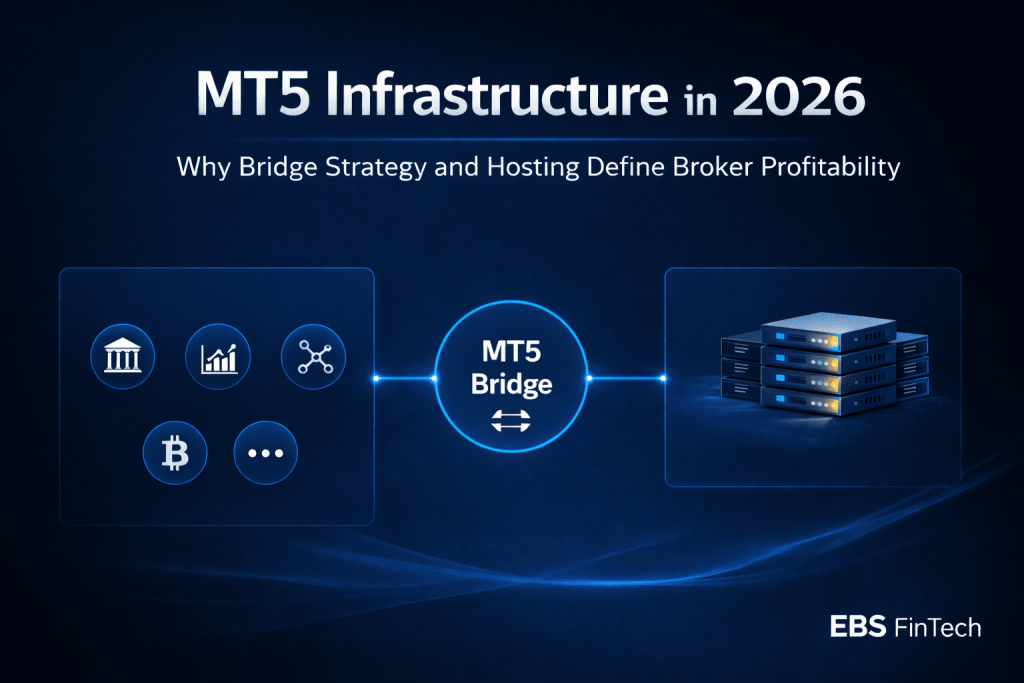
What’s actually separating firms that grow sustainably from those that quietly struggle isn’t the platform they’re on. It’s everything that sits behind it: how the bridge is architected, where liquidity comes from and how it’s structured, where servers live and why, and whether anyone is genuinely maintaining the environment over time rather than just keeping the lights on.
These aren’t purely technical questions anymore. They’re business questions.
Why MT5 Itself Stopped Being the Point
Walk through any serious broker’s technology stack and you’ll notice something: the front end often looks nearly identical across competitors. Same interface, similar instruments, comparable client facing features. Traders switching from one MT5 broker to another don’t always notice a meaningful difference at first.
The differences show up later — in execution consistency during volatile sessions, in how pricing behaves across different instruments, in whether the platform feels reliable or vaguely unstable in ways that are hard to articulate but easy to feel.
Two brokers can both run MT5 and have completely different operational realities. One has clean routing, predictable costs, and a support team that can actually respond when something goes wrong. The other has a bridge that’s fine until it isn’t, liquidity feeds that misbehave under pressure, and a hosting setup that nobody fully understands anymore. Both have MT5. Only one has infrastructure.
That gap is where the competition is actually happening now.
The Bridge Is No Longer Just Middleware
For a long time, the bridge was treated as a necessary piece of plumbing. You needed it to connect the platform to liquidity, it cost what it cost, and you moved on. Pricing was variable, and as volume grew, so did the bill — that was just accepted.
That logic is getting harder to sustain.
When bridge costs scale directly with volume, growth doesn’t automatically mean better margins. Sometimes it reveals the opposite. More flow can expose inefficiencies in routing logic, symbol configuration, and how liquidity is being distributed across client types. Infrastructure decisions that once felt technical start showing up in P&L.
This is why more firms are now looking at their bridge architecture not just as a performance question but as a cost model question. Does this setup make sense at the volumes we’re targeting? Is the routing logic matched to how our clients actually trade? Can we grow without the infrastructure overhead growing faster than the revenue?
The bridge isn’t middleware anymore. It’s part of the financial model.
Liquidity Architecture Is Getting Complicated — and That’s Not Going Away
The old liquidity setup was relatively straightforward. Connect to a prime of prime (PoP) or aggregator, make sure spreads are competitive, make sure execution is reliable. That still matters, but the landscape has gotten messier.
Firms today are evaluating multiple layers at once — native MT5 compatible liquidity, external prime connections, and increasingly, liquidity models that have emerged from the crypto and DeFi space. That’s a wider set of options than most operators were thinking about a few years ago.
More options, though, means more decisions. How do you unify different liquidity sources inside one MT5 environment without creating pricing inconsistencies? How do you manage latency differences between feeds? What happens to your risk exposure when client flow doesn’t match what’s happening upstream?
None of these are niche problems anymore. They come up in conversations with operators across firm sizes and models.
The shift that’s happening is that liquidity strategy is becoming less about how many providers you’re connected to and more about how those connections are structured and controlled. The brokers that are ahead of this aren’t just connected to liquidity — they’ve built an execution framework around it.
Hosting and Maintenance: The Unglamorous Part That Actually Matters
Hosting is one of those areas where the gap between how it’s perceived and how much it actually matters is surprisingly large.
There’s still a tendency to think of it as a background IT concern — something you set up once and don’t really revisit unless something breaks. In practice, the stakes have risen considerably.
Modern MT5 operations have to support multi region client bases, cross border liquidity access, and a growing number of integrations across payment processors, CRMs, compliance tools, and prop specific systems. Each additional dependency means another potential failure point. The hosting environment has to hold all of that together.
When it doesn’t, the effects compound. Execution delays bleed into client experience. Bridge instability creates settlement problems. Avoidable downtime during volatile sessions is the kind of thing traders remember — and mention in reviews.
The same goes for maintenance, which often gets treated as reactive rather than proactive. Updates get delayed. Version compatibility issues accumulate. Monitoring gaps mean problems sit undetected until they’re already affecting clients. A broker doesn’t usually lose its client base in one dramatic incident. It loses them gradually, through enough small frictions that eventually the platform just doesn’t feel worth staying on.
Hosting, in 2026, is infrastructure. Not IT.
What This Means in Practice
For firms planning to launch, scale, or rebuild in 2026, the core question isn’t really about platform selection anymore. It’s about whether the infrastructure behind the platform is designed to support the business you’re trying to build — not just at launch, but six months and two years after that.
A thin infrastructure model can get a firm live. It can work for a while. But it tends to create recurring friction: costs that don’t scale cleanly, execution inconsistency that drives churn, integrations that require ongoing manual attention, and a general sense that the operation is always slightly behind where it should be.
A well designed infrastructure model creates headroom. It gives the business room to grow without the foundation cracking under the pressure.
That’s what the market is reflecting right now. MT5 still matters — but the value has shifted up the stack, into architecture, integration, and the ongoing operational discipline that keeps everything running well.
At EBS FinTech, we work with brokers and prop firms across various stages of growth — from initial MT5 setup to full infrastructure design, bridge and liquidity integration, hosting architecture, and ongoing maintenance. The goal is always the same: an environment that’s built to operate reliably and scale without requiring constant firefighting. If you’re thinking through your next phase, that’s the conversation we’re set up to have.