- FIX API: the language, not the connection
- MT5 Gateway: the component that plugs into the server
- Liquidity bridge: the execution management layer
- One recent change worth noting
- Which layer does your brokerage need?
- Is a gateway faster than a bridge?
- Where these projects actually go wrong
- Recurring mistakes
- A selection framework
- How EBS FinTech supports MT5 liquidity projects
When a new Forex or CFD brokerage says it needs to “connect MT5 to a liquidity provider,” the request sounds like a single purchase. It rarely is. A working liquidity setup usually involves a messaging protocol, an MT5 side connectivity component, an execution or aggregation engine, symbol mapping, routing rules, hosting, monitoring and daily reconciliation — supplied sometimes by one vendor, more often by three or four.
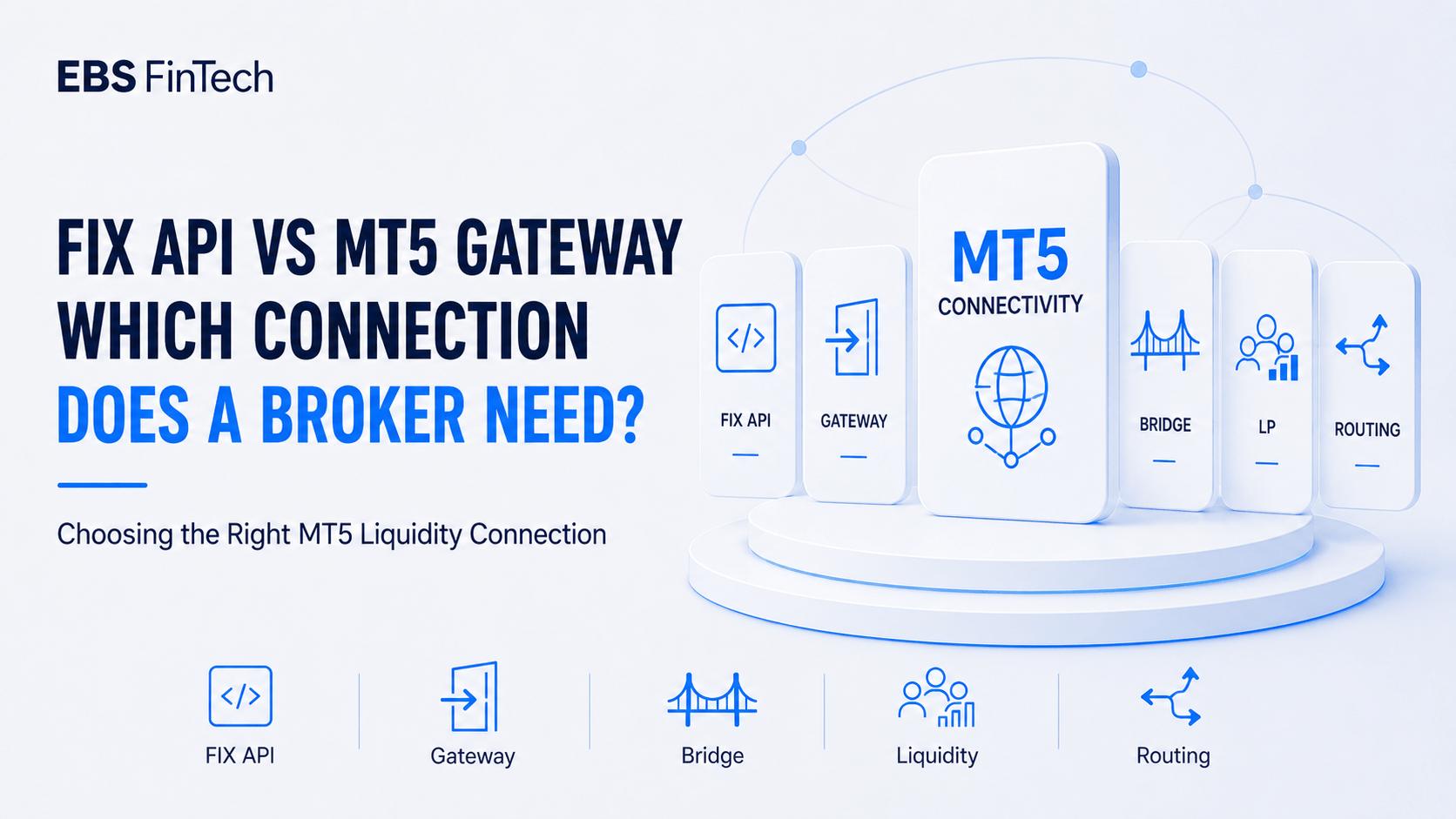
That is why FIX API, MT5 Gateway and liquidity bridge get used interchangeably. They frequently appear in the same architecture, but they sit at different layers, and one does not substitute for another.
FIX API: the language, not the connection
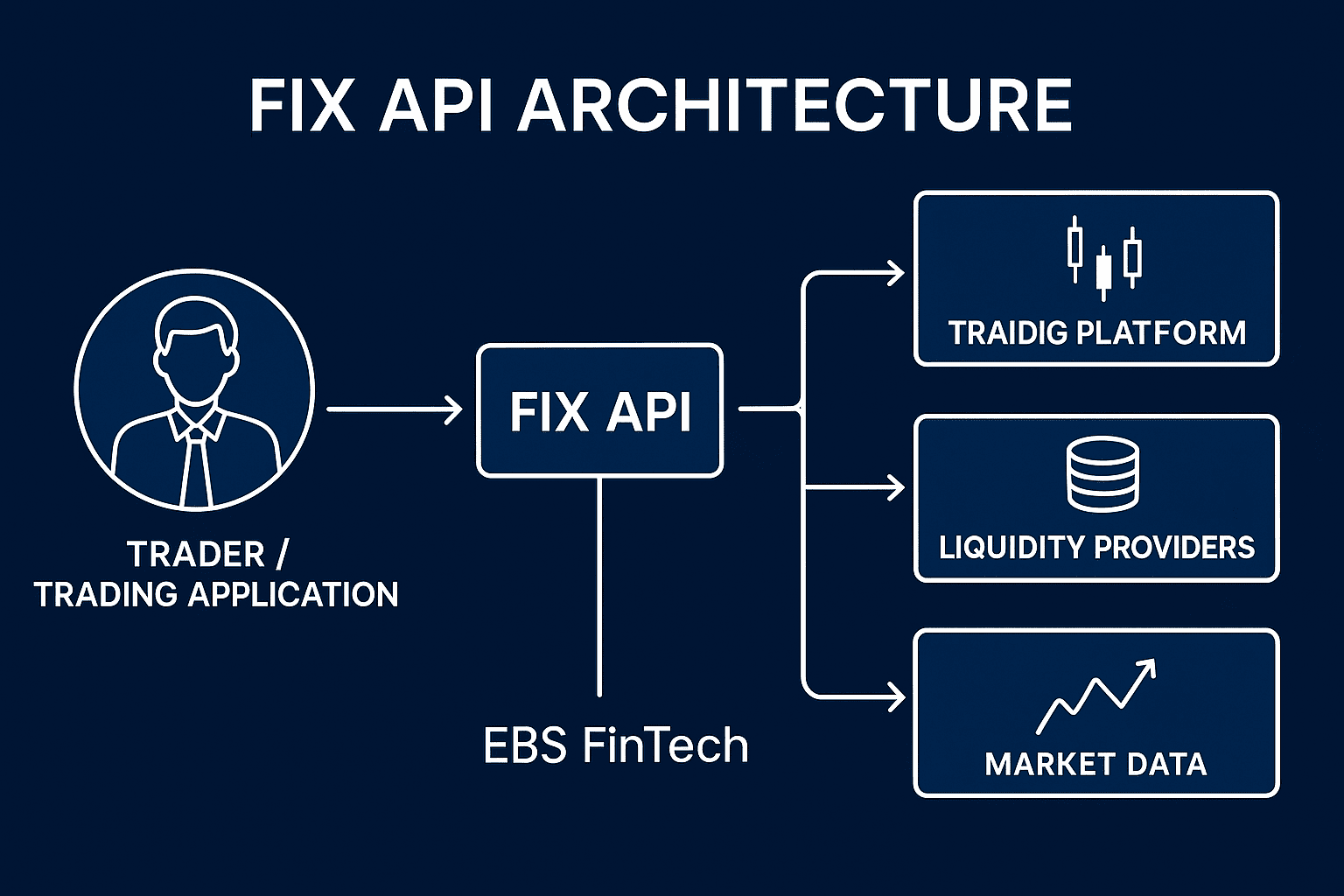
FIX — Financial Information eXchange — is an industry messaging standard for exchanging trading information between financial systems. Depending on what the two counterparties implement, it can carry market data, new orders, cancels and amendments, execution reports, partial and complete fills, rejects, and order status.
A FIX connection has two halves. The session layer handles logon, heartbeats, sequence numbers, resend requests and recovery after a disconnect. The application layer defines which trading messages the two sides actually support and how each field is interpreted.
This is why “the LP offers a FIX API” does not mean the connection is close to ready. Before going live, both parties still have to agree on the FIX version or implementation profile, sender and target identifiers, IP access, session schedule, supported order types, symbol identifiers, price precision and quantity format, the execution report workflow, reject code handling, sequence reset procedure and encryption requirements. FIX is a common language; every counterparty relationship still needs its own implementation, certification and testing cycle.
MT5 Gateway: the component that plugs into the server
An MT5 Gateway is a server side component that integrates the MetaTrader 5 environment with an external trading system, venue or execution engine. MetaQuotes provides a Gateway API for exactly this purpose — connecting MT5 to other trading systems and building custom data feeds.
Depending on its design, a gateway may receive and translate external prices, route eligible orders for execution, return fills, partial fills, rejects and status updates, and maintain the order, deal or position state required by the integration.
Crucially, the external face of a gateway may itself speak FIX, or a proprietary vendor protocol. FIX API and MT5 Gateway are therefore not competing choices. The cleaner way to say it: FIX defines how two systems exchange trading messages; an MT5 Gateway is what carries those messages into the MetaTrader 5 server workflow. A broker generally cannot take generic FIX credentials from an LP and enter them directly into MT5. The connection must still be implemented through a compatible gateway, bridge, native connector or matching engine integration.
Liquidity bridge: the execution management layer
A bridge sits between the trading platform and external liquidity. In its simplest form it moves prices in and orders out. Commercial products go considerably further, typically adding multi LP aggregation, best bid and offer construction, depth merging and book sweeping, smart order routing, symbol or group level markups, A-Book, B-Book and Hybrid rules, exposure management, LP failover, execution quality analytics and audit logging.
Product literature from PrimeXM, oneZero and Centroid shows how much of this now ships bundled. Feature sets still differ materially between products, so the category name settles very little.
The word “bridge” is also slightly misleading, because the piece that touches MT5 may itself be a gateway: a vendor can market the whole product as a liquidity bridge while installing a gateway component on the MT5 server that then talks to a central engine elsewhere. What matters in evaluation is the actual data flow and who controls each hop, not the label on the datasheet.
| Area | FIX API | MT5 Gateway | Liquidity Bridge / Hub |
|---|---|---|---|
| Primary role | Standardised trading messages | Connects MT5 to an external system | Manages pricing and execution between platform and liquidity |
| Nature | Protocol and message standard | MT5 server-side component | Middleware / execution-management system |
| Connects to MT5 directly | Not on its own | Yes | Usually via a gateway, plugin or connector |
| External protocol | FIX | FIX, proprietary or venue-specific | FIX and other venue protocols |
| Multiple LPs | Needs a separate aggregation engine | Depends on the gateway and engine | Common in advanced products |
| Price aggregation | Not provided by the protocol | Implementation-dependent | Common |
| A/B-Book routing | Build separately | Depends on the connected solution | Common |
| Markups, liquidity pools | Build separately | Product-dependent | Common |
| Reporting | Requires development | Product-dependent | Usually included |
| Operational burden | High if built in-house | Moderate | Moderate to high |
| Typical user | Institutions, proprietary platforms and OMS | MT5 brokers with a defined external venue | Brokers needing aggregation, routing and risk control |
Capabilities vary between vendors and product tiers. Confirm functionality directly with the relevant provider during technical due diligence.
One recent change worth noting
The MT5 ecosystem is no longer limited to point to point gateways and third party bridges. MetaQuotes was publicly presenting Ultency as a newly released solution last year. Ultency is a native liquidity aggregation, order matching and risk management engine for MetaTrader 5, and its network of connected brokers and liquidity providers continued to expand through 2025 and 2026.
The practical consequence is that the technology decision is no longer simply “native gateway or third party aggregator.” Brokers now have to compare MetaTrader native aggregation against external bridge and hub architectures on function, cost, control and — most importantly — how difficult it would be to move later. Specific capabilities and commercial terms should be confirmed directly with MetaQuotes or an authorised representative rather than taken from secondary sources.
Which layer does your brokerage need?
Direct FIX integration earns its complexity when the requirement extends beyond a standard MT5 liquidity connection. That usually means the firm runs its own trading front end, OMS or matching engine; operates several platforms that should share one central execution layer; needs to offer FIX connectivity to institutional clients; is building its own aggregator; or requires custom order types, internal matching, specialised credit controls or deep integration with other institutional systems. The benefit is control. The cost is that development, certification, session monitoring, exception recovery, reconciliation and every future counterparty upgrade become the firm’s own responsibility.
An MT5 Gateway tends to fit a brokerage operating an MT5 White Label with a clearly identified primary LP or venue, straightforward routing requirements, no plan to build an institutional execution platform, and access to a mature supported gateway for that counterparty. It produces a clean architecture — but fewer components is not the same as easier to manage. Monitoring, failover, reporting, exposure management and migration paths all still need answers, and a design that suits one LP can become restrictive once a second LP, a new asset class or a more complex risk model arrives.
A bridge or aggregator becomes the right answer when several execution variables have to be managed centrally: multiple LPs, merged pricing from different sources, distinct liquidity pools, different MT5 Groups routed to different execution paths, A Book/B Book/Hybrid models, markups by symbol or group or time of day, net exposure management, automatic overflow hedging once a threshold is hit, execution quality comparison between providers, backup liquidity, and consolidated reporting across servers or platforms. Aggregation methodology, last look handling, reject logic, depth construction and partial fill processing vary widely between vendors, so evaluation has to walk through the actual order lifecycle rather than compare feature lists.
Is a gateway faster than a bridge?
Not reliably. Removing a software hop can reduce some processing overhead, but the number of named components is a small part of end to end latency.
What else shapes it: where the MT5 trade server sits, where the gateway or bridge engine sits, where the LP’s pricing and matching infrastructure sits, whether the path uses public internet, private line or cross connect, message conversion and normalisation, aggregation calculations, pre trade risk checks, queueing during volatility, server load, logging requirements, the LP’s own response time, and failover design.
Colocating MT5, the bridge and the liquidity endpoint in the same financial data centre region generally reduces network delay. It does not by itself produce good execution. Fill ratio, reject rate, slippage, quote stability and behaviour around news events all have to be measured. The useful test is not whether a vendor calls its product a gateway or a bridge; it is measured end to end performance under realistic flow.
Where these projects actually go wrong
Symbol mapping. Establishing the session is the easy part. Every externally executed instrument has to be mapped correctly between MT5, the bridge and the LP. The implementation team should confirm, item by item:
- Symbol name on both sides and the external identifier
- Digits, tick size, contract size
- Minimum and maximum volume, volume step
- Trading hours and holiday schedule
- Base, profit and margin currencies
- Swap configuration and currency conversion symbols
- Margin calculation method
- Supported order types and execution policy
- Price limits and deviation rules
Two systems can use the same commercial name for an instrument and still differ underneath — one expressing volume in lots, the other in units or notional value. Wrong conversion logic produces rejects, wrong hedge sizes, margin discrepancies and P&L differences nobody can explain. Symbol mapping belongs in the change control process, not in the last afternoon before launch.
Failure handling and reconciliation. FIX sequence numbers and resend requests detect and recover missing messages; execution reports carry acknowledgements, status, fills and rejects. Those mechanisms do not replace the brokerage’s own reconciliation. A production design has to define behaviour when a session drops, when sequence numbers diverge, when a possible duplicate message arrives, when an order is acknowledged but never finalised, when an execution is received twice, when the price feed stops while the trading session stays open, when the primary LP disconnects, when MT5 and the LP show different final positions, and when failover triggers with orders still open. Daily reconciliation should compare MT5 deals and positions against gateway, bridge and LP records, with exceptions investigated using stable identifiers, execution IDs, timestamps and raw messages. Without it, an unmatched hedge tends to surface only after the exposure has moved.
Access control. A liquidity connection touches live orders and real exposure, so it warrants stricter control than an ordinary application integration: FIX credentials and session identifiers, IP allowlists, VPN or encrypted transport, MT5 Administrator and Manager permissions, bridge and gateway admin roles, vendor remote access rights, MFA where supported, secure credential storage and rotation, configuration change logs, and access review after staff or supplier changes. Production credentials should not live in ordinary email or messaging threads, and development, UAT and live environments should use separate credentials and change procedures.
Recurring mistakes
New brokerages tend to treat FIX as a complete bridge, and are surprised when it delivers no aggregation, markups, A/B Book routing or exposure dashboards. They assume a gateway is automatically faster. They pick the connectivity model before confirming the LP, when the LP’s supported protocols, data centre locations, instrument coverage and certification requirements often narrow the options for them. They begin testing without a completed symbol matrix, so prices look right while volume, tick value, margin or session settings are wrong. They test successful market orders only, skipping limits, stops, partial fills, rejects, disconnects, sequence recovery, stale prices and failover. They run demo on different logic from live. They push every client group down one execution path. They skip reconciliation, assuming a client fill proves the external hedge was booked. And they choose a vendor without asking how configurations, historical records and LP relationships would migrate if the relationship ends.
A selection framework
Before committing to FIX, a gateway, native MT5 aggregation or a third party bridge, answer these:
- Which trading platforms will the firm operate?
- Is it running an MT5 Main Label?
- How many LPs are needed at launch, and later?
- Is price aggregation required?
- A Book, B Book or Hybrid?
- Is routing needed by client, group, symbol or exposure level?
- Do institutional clients need FIX connectivity?
- Which execution, management and regulatory reports are required?
- Where are the MT5 servers and the LP infrastructure located?
- Who monitors the connection outside business hours?
- How are failover and daily reconciliation handled?
- Which costs are fixed, volume based or per LP?
- How hard would it be to replace the LP or the technology vendor?
The answers usually make the architecture obvious. One MT5 server, one primary LP and straightforward external execution points to a supported gateway. Multiple LPs, differentiated liquidity pools and hybrid routing points to native MT5 aggregation or a third party bridge. Several platforms or a proprietary OMS points to a central FIX execution layer.
How EBS FinTech supports MT5 liquidity projects
EBS FinTech works with brokers across the implementation and operational layers of an MT5 liquidity build: MT5 White Label deployment, gateway configuration, FIX and LP technical coordination, bridge and aggregator integration, symbol and contract specification mapping, MT5 Group and routing configuration, demo and live testing, server hosting and network architecture, monitoring and incident troubleshooting, MT4/MT5 maintenance, and backup, failover and change management.
Our role is infrastructure implementation and coordination. Commercial terms, liquidity pricing, execution quality and regulatory obligations remain matters between the brokerage and its own counterparties and advisers. What we can be accountable for is that the infrastructure is built to the agreed design, documented, monitored and supportable after launch.
Disclaimer: EBS FinTech provides technology infrastructure and implementation services only. We do not provide brokerage services, do not hold or manage client trading funds, and do not solicit individual investors. Nothing above constitutes legal, regulatory or investment advice. Product capabilities, licensing terms and vendor functionality should be verified directly with the relevant provider.