- What Liquidity Aggregation Actually Does
- LP, Bridge, Aggregator, Gateway and FIX API
- Why Brokers Add More Than One LP
- How the Aggregated Price Book Is Built
- Order Routing: Price Is Only One Input
- Partial Fills and Order Splitting
- Single LP vs Multi LP Aggregation
- Symbol Mapping and Contract Normalization
- Where Latency Actually Comes From
- What to Measure After Launch
- Failover That Has Been Tested
- Choosing an Aggregator
- How EBS FinTech Supports Liquidity Aggregation
- FAQ
Adding a second or third liquidity provider is usually framed as an upgrade — tighter pricing, deeper books, somewhere to send flow when one counterparty goes quiet. That can be true. It is equally true that every new connection arrives with its own symbol names, contract specifications, quote behaviour, session calendars, rejection codes and reconciliation records, and those differences do not reconcile themselves.
Liquidity aggregation is the layer that reconciles them. Done properly, it turns several inconsistent feeds into one governable pricing and execution environment. Done carelessly, it produces more connections, more messages and more support tickets without improving a single fill.
For a broker with modest volume and a narrow product range, one well matched LP often remains the cleaner starting point. For a broker with modest volume and a narrow product range, one well-matched LP often remains the cleaner starting point, and liquidity is only one of the components involved in building an MT5 brokerage.
What Liquidity Aggregation Actually Does
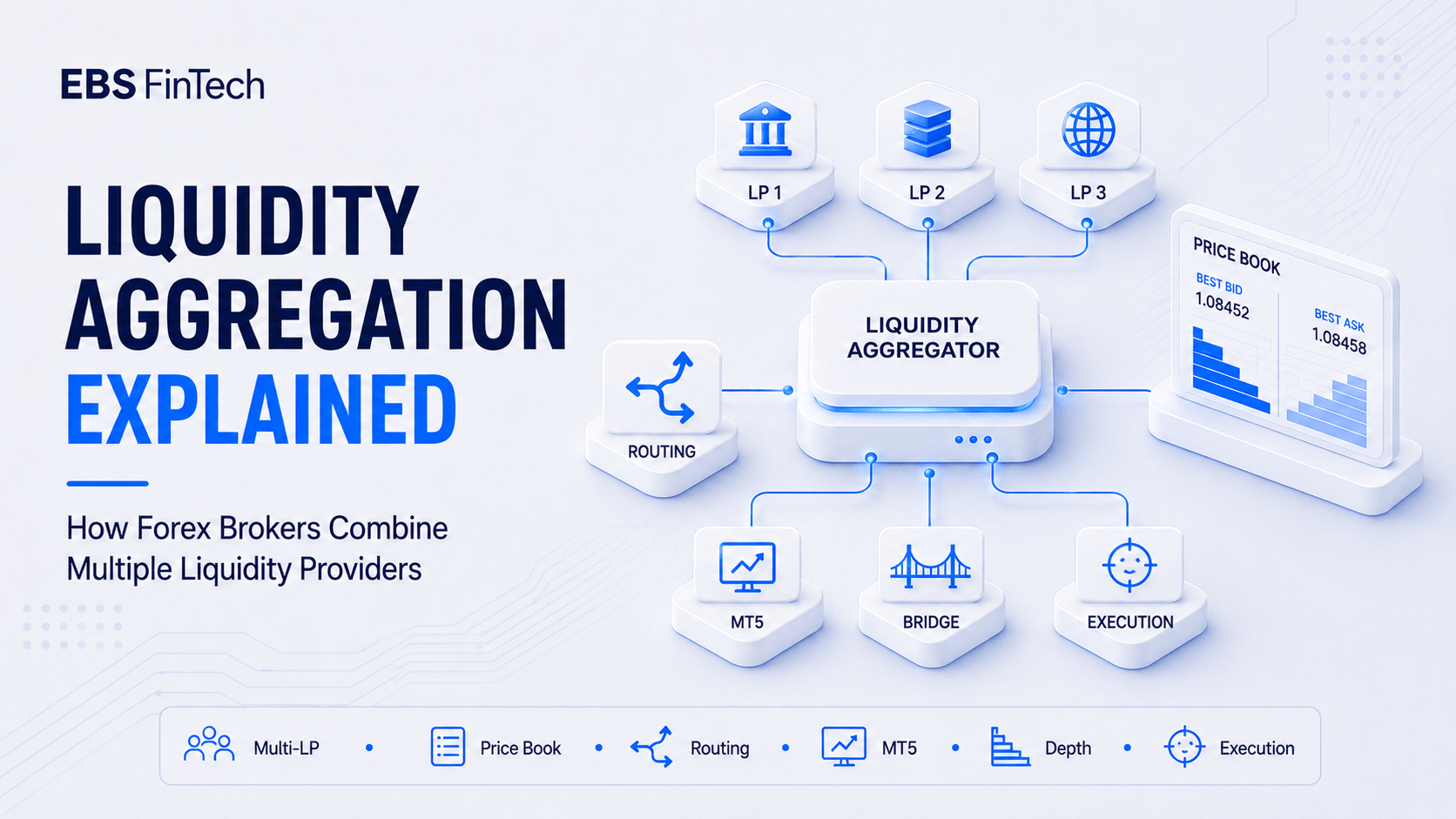
An aggregator receives market data and execution messages from several providers — bid and ask prices, size at each level, depth of market, timestamps, session status, acknowledgements, full and partial fills, rejections and, where provided, the associated reason codes, and cancel/replace responses — then normalizes all of it into a single format.
From that normalized stream it builds one or more liquidity pools. Note the plural. There is no requirement that the whole brokerage share one feed. Retail accounts, professional accounts, high volume clients and the internal hedging book can each sit on a different LP combination, markup structure and routing policy, mapped to MT5 Groups where the selected bridge or aggregation system supports group-based routing.
One caveat runs through everything below: a displayed quote is not a guaranteed fill. Quote age, available size, last look policy, minimum trade size and market movement between request and execution all sit between the price on screen and the price in the trade report.
LP, Bridge, Aggregator, Gateway and FIX API
These terms travel together and are often used interchangeably. They are not the same thing.
A liquidity provider supplies prices and accepts eligible trade requests — a bank, a non bank market maker, a prime of prime, an ECN, an exchange or another institutional venue.
A bridge moves prices, orders and execution results between the trading platform and the external execution environment.
An aggregator merges multiple pricing streams, constructs the price book and allocates orders among eligible sources.
A gateway is typically a direct MT5 integration with a specific external provider, execution venue or aggregation system. Where it connects to an aggregation system, the merging of liquidity happens on that system’s side — using an MT5 Gateway does not in itself give the broker a multi LP environment under its own control and configuration.
FIX API is a widely used messaging standard for exchanging market data, orders and execution reports between trading systems. It is not, by itself, a bridge, an aggregator or a source of liquidity, and not every bridge, gateway or aggregator communicates over FIX — proprietary and platform native interfaces are also common.The functional boundary between the two is covered separately in how FIX API and MT5 Gateway differ in practice.
One further distinction is worth drawing. Aggregation is a function, not a fixed position in the stack. It may sit in a standalone aggregator, inside a bridge, on the external provider’s side, or within the liquidity management components of the trading platform itself. What determines the broker’s actual room to operate is which liquidity pools, pricing rules and routing parameters it can see and change — and that follows from the components deployed, the permissions granted and the vendor’s commercial arrangement.
Commercially, the functions overlap constantly. A product sold as a liquidity bridge may also carry aggregation, smart order routing, risk controls and execution reporting. Judge these systems by function, not by product name.
Why Brokers Add More Than One LP
Price competition is the obvious answer. With several eligible providers quoting the same instrument, the pool can draw on the best available bid and ask.
It is rarely the only answer, and often not the main one. Additional providers can extend executable depth, widen instrument coverage, reduce dependence on a single counterparty, create backup execution routes, separate different types of order flow, improve coverage across sessions, and give the broker a basis for comparing execution quality rather than accepting one provider’s version of it.
Performance is also uneven by design. A provider that is strong on majors during the London session may be unremarkable on metals or indices. Another may quote tightly and reject frequently once volatility rises. A third may show a slightly wider top of book spread but absorb size more consistently. Very little of this is visible in an advertised spread.
How the Aggregated Price Book Is Built
Before quotes are combined, the aggregator decides which ones qualify. For each instrument it compares normalized bids and asks from the selected providers; the highest eligible bid and the lowest eligible ask form the Best Bid and Offer for that pool.
That BBO is the best price among the sources this broker happens to be connected to. In OTC Forex it is not a market wide consolidated quote, and it should not be presented to clients as one.
Where depth is supplied, the aggregator can also stack volume across levels — the best price may cover only part of the requested size, with the balance filling from another provider or a worse level. Quotes typically pass through symbol and contract normalization, quote age and stale price filtering, abnormal spread and price band controls, minimum and maximum volume checks, provider availability and session validation, then LP level and broker level markups.
Two further points deserve attention because they are routinely missed.
The first is duplicated liquidity. Feeds arriving from different counterparties may ultimately originate with the same bank, market maker or venue. Connecting both may therefore add less independent market depth than the connection count suggests. Counterparty diversification is a separate question — it depends on the legal counterparties, credit arrangements and execution chain, and two feeds sharing an upstream source can still sit behind genuinely different credit exposures, operating systems and failure domains.
The second is last look. Where a provider operates a last look window, it performs defined price and validity checks after receiving the request and before accepting it. Policies differ, and streaming quotes from different providers do not carry identical execution certainty. Brokers should confirm each provider’s last look rules — what checks are applied, in which circumstances, and how rejections are handled — from the liquidity disclosure, execution policy or commercial terms, since that detail is not always contained in the master agreement.
Order Routing: Price Is Only One Input
Once the book exists, something has to decide where each order goes.
The simplest rule sends the order to whoever shows the best price. It is easy to explain and frequently suboptimal, because the tightest quote may come with a lower fill rate, slower response, thinner size, more negative slippage or a stricter last look policy.
More considered setups combine several logics. Price time priority ranks on price and breaks ties on quote arrival. Volume based routing matches order size against available depth. Weighted and round robin allocation distribute flow across eligible providers by fixed or adjusted proportions. Client-, group- and symbol-based routing assign different pools by account category, MT5 Group or instrument. Exposure based routing shifts destination according to the broker’s net position and hedging requirement.
Flow analysis usually sits alongside this. Latency sensitive activity, news event trading, one sided exposure, very short holding periods, high cancellation rates and provider specific slippage patterns all inform whether a given flow stays internal, gets hedged externally or moves to a provider better suited to it.
One caution here matters more than most. Profitability is not evidence of toxic flow. A consistently profitable client may simply be trading well. Classification should rest on measurable execution behaviour and documented criteria written into risk policy — labelling every winning client as toxic produces unequal execution treatment, disputes, and eventually the wrong risk decisions.
The working principle is that the lowest displayed spread and the lowest completed execution cost are different numbers.
Partial Fills and Order Splitting
A small order may fill entirely with one provider at one price. A larger one may not.
The engine can send the whole order to a single LP, split it across several, fill part and reroute the remainder, sweep multiple levels of the aggregated book, or reject the unfilled balance when suitable liquidity is not there.
Once an order is split, the resulting external execution price is normally derived from several fills, commonly as a volume weighted average. Whether the client receives that same blended price is determined mainly by the broker’s execution model, markup policy and bridge configuration. The MT5 fill policy sits one layer away from that question — it governs whether partial execution is permitted and what happens to any unfilled quantity, which shapes how the external fills occur rather than how the resulting price is passed through to the client account. External hedge executions and client account executions do not necessarily correspond fill for fill.
Splitting improves access to depth at the cost of more execution messages, more reconciliation and potentially more latency. How partial fills are represented in MT5, and what happens to the remaining quantity, differs by order type, instrument and LP agreement — which makes it a testing item before launch, not a documentation item.
Single LP vs Multi LP Aggregation
| Area | Single LP | Multi LP Aggregation |
|---|---|---|
| Architecture | Relatively simple | More complex |
| Counterparty dependence | Higher | More diversified |
| Price competition | One source | Competition among eligible sources |
| Product coverage | Set by one provider | Combined coverage |
| Maintenance cost | Lower | Higher |
| Reconciliation | More straightforward | More records, more counterparties |
| Failover | Limited unless configured | More flexible |
| Routing control | Simpler | More granular |
| Execution analysis | One external source | LP level comparison required |
| Operational workload | Lower | Higher |
More providers is not automatically better. A broker with low volume may lack the flow to hold attractive commercial terms across several relationships, and each LP receiving a small sample makes routing performance harder to judge. One provider with stable execution, the right products and responsive support can outperform four poorly matched ones.
Symbol Mapping and Contract Normalization
Providers name the same instrument differently — EURUSD may appear as EUR/USD, EURUSD.r, EURUSD.pro or something proprietary. The name is the shallowest of the differences.
Before liquidity is combined, verify across MT5, the bridge and each LP specification:
- Symbol identifier, digits, contract size
- Tick size and tick value
- Minimum and maximum volume, volume step
- Base and quote currency
- Trading hours and holiday schedule
- Margin calculation and swap treatment
- Expiry and CFD corporate action treatment
- Price and volume multipliers
Two products that look like the same market cannot share a pool until their economic and technical specifications line up. Mismatches surface as rejected orders, wrong hedge sizes, distorted price conversion, incorrect margin, and client positions that do not agree with the external hedge. These three configuration sets — MT5 symbols, bridge mapping, LP specifications — should be reviewed as one document, not maintained separately by three teams.
Where Latency Actually Comes From
Execution latency is a property of the whole path, not of one server. An order typically passes through the client terminal, the MT5 Access Server, the MT5 Trade Server, the gateway or bridge, the aggregation and risk engine, the LP’s access layer, the provider’s execution venue, and then the return path for the execution report.
Data centre location, cross connects, internet routing, firewall inspection, risk rule computation and system load each contribute. Placing the MT5 server beside the bridge shortens one segment; it does nothing about an unstable link between the aggregator and the LP. Hosting the aggregator in a financial data centre does nothing about blocking log writes or an inefficient database dependency inside the risk engine.
Measure by segment. A single end to end average conceals which layer is responsible, which is precisely the thing you need to know.
What to Measure After Launch
Evaluate the execution received, not the prices displayed. The useful set is:
- Fill rate, reject rate, partial fill rate
- Execution latency
- Positive and negative slippage, price improvement
- Spread consistency and quote availability
- LP uptime, volume by LP, order size by LP
- Performance by symbol and by session
- Requote rate where the execution model permits requotes
- Rejection reasons
- Cost per unit of executed volume
Segment all of it. A healthy monthly fill rate can sit on top of one provider failing consistently on one symbol, above a certain order size, or during specific volatility windows.
Reject codes deserve individual treatment rather than a generic “failed” bucket. Insufficient margin, invalid symbol, closed market, stale price, volume rule breach and an LP risk decision each call for a different fix.
Failover That Has Been Tested
Multiple connections improve resilience only when the failure behaviour has been designed and rehearsed. Decide in advance what happens when a provider stops quoting, when prices go stale, when the primary bridge drops, when a session shows connected but stops responding, when market data arrives but orders fail, and when MT5 loses the aggregation layer entirely.
The usual controls are backup providers and secondary feeds, automatic exclusion of misbehaving sources, maximum quote age and exposure limits, symbol level suspension, close only mode, manual routing override, incident alerting and post incident reconciliation.
Failover should not mean redirecting everything to whoever is still online. The backup source needs its symbol specifications, available size, pricing behaviour, trading hours and commercial limits validated beforehand — otherwise a technically successful switch creates a trading and risk problem instead of solving one.
Choosing an Aggregator
Most aggregation failures are not exotic. They come from assuming more LPs equals better liquidity, comparing quoted spreads instead of completed execution, treating displayed depth as guaranteed size, never reviewing routing rules against execution data and LP performance, running without a tested backup, applying one policy to every client and symbol, letting aggregator rules drift out of alignment with MT5 Groups, mixing broker and LP markups without clear reporting, relying entirely on the vendor dashboard, and underestimating hosting, connectivity, support and LP related costs.
Define requirements before comparing feature lists:
- How many LPs are genuinely required, and for which instruments?
- What is the expected monthly volume, typical order size and maximum order size?
- Which client categories, and A Book, B Book or hybrid?
- Is full market depth needed? Are partial fills and order splitting supported?
- Is automatic exposure hedging required?
- Which routing rules are configurable, and which execution reports are produced?
- Can results be analysed by LP, symbol, group and order size?
- Where will the MT5 server and the aggregation engine sit?
- What failover functions exist, and have they been demonstrated?
- How are technology, connectivity and transaction fees calculated?
- Who monitors and maintains the environment after launch?
The right system is not the one with the most features. A routing engine the dealing and operations teams cannot maintain will underperform a simpler setup with clear controls and support that answers.
How EBS FinTech Supports Liquidity Aggregation
EBS FinTech works with brokers on the technical planning, integration and ongoing operation of MT5 liquidity infrastructure. Depending on project scope, that can cover MT5 Main Label setup, liquidity provider coordination, bridge and aggregator integration, FIX connectivity, multi LP configuration, symbol mapping and contract specification review, routing rule configuration, MT5 Group alignment, demo and live testing, server hosting, connectivity monitoring, execution troubleshooting and ongoing maintenance.
The emphasis in deployment is on whether the configuration sets agree with each other — MT5 symbols and groups, bridge rules, LP specifications, external execution reports — rather than on completing the connection and declaring the project finished.
FAQ
Does connecting more liquidity providers always improve execution?
No. Independence and quality of the sources matter more than the count. Feeds that ultimately originate from the same venue may add less independent market depth than the connection count suggests, and low volume spread across many providers can weaken commercial terms and make execution analysis harder.
Is an MT5 Gateway the same as a liquidity aggregator?
Not necessarily. A gateway is a direct integration with a specific external provider, execution venue or aggregation system. Where it connects to an aggregation system, the merging happens on that system’s side. Aggregation itself is a function rather than a fixed component — what matters is which pools, pricing rules and routing parameters the broker can actually configure.
Why is my final execution price different from the quote I saw?
Where an order is split across levels or providers, the external execution result is normally derived from several fills and can form a volume weighted average. Whether the client account receives that same blended price depends on the broker’s execution model, markup policy and bridge configuration. Quote age, available size, last look checks and market movement between request and execution also affect the outcome.
Disclaimer: EBS FinTech provides technical infrastructure and operational services. We do not provide brokerage services, do not hold or manage client trading funds, and do not solicit individual investors. Licensing outcomes, liquidity provider terms, regulatory approvals and banking arrangements are determined by the relevant licensed institutions and competent authorities. This article is for general information only and does not constitute legal, tax, regulatory or investment advice.