MT5 Alone Doesn’t Run a Brokerage
Most new brokers begin with the same three questions: how do we get MT5, where does liquidity come from, and how do we host the server? Those are reasonable places to start. MetaTrader 5 is the trading platform, liquidity provides market access, and hosting keeps everything online. The problem is that all three together still only describe the trading environment — not the business that has to run around it.
A live forex or CFD brokerage spends most of its day on everything that happens outside the trading screen: registering clients, reviewing documents, opening accounts, processing deposits and withdrawals, assigning groups and leverage, attributing IBs, tracking sales followups, answering client requests, and keeping records that someone can actually pull up and review later. None of that lives in MT5.
This is the part many brokers underestimate, usually because they haven’t started operating yet. A Forex CRM is what connects the client, the trading platform, the back office, payments, the IB network, and compliance into one workflow. Skip it, and a perfectly stable MT5 setup can still turn into a mess the moment real clients and real money start moving — and by the time you bolt a CRM on later, you’re migrating messy spreadsheets and reconstructing history that was never recorded properly.
What a Forex Broker CRM Actually Does
In most industries, “CRM” means lead tracking, contact notes, and sales follow up. For a broker it has to do considerably more. A broker CRM has to carry the full client lifecycle — from the first registration, through KYC review, account opening, funding, IB attribution, and ongoing support, all the way to the reports that finance and compliance need.
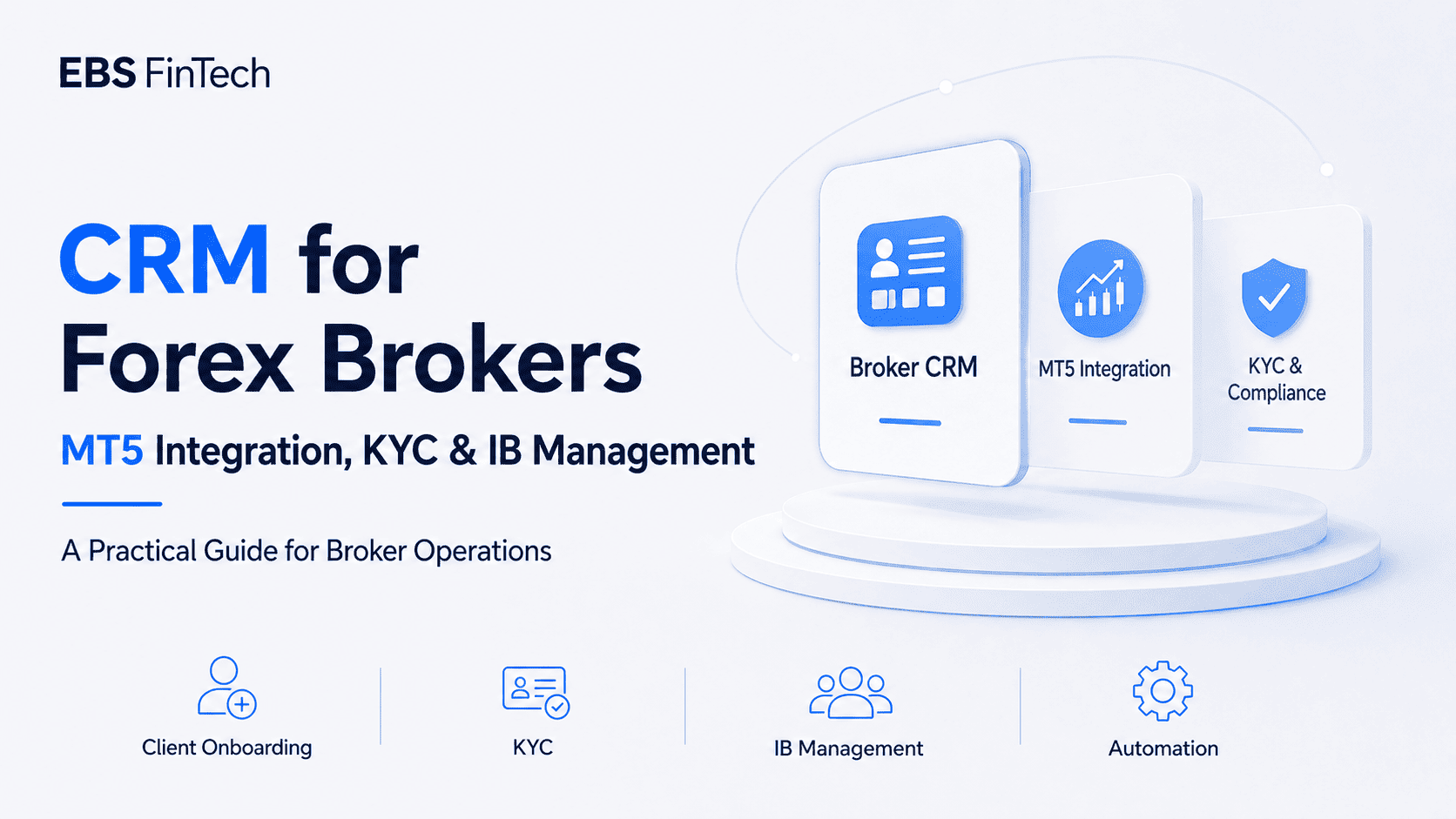
In practice that covers client registration and onboarding, KYC document collection and review, sales pipeline management, MT5 account creation, group and leverage assignment, deposit and withdrawal workflows, IB and rebate tracking, support records, role based permissions, and audit logging.
At launch, plenty of these look optional. They stop looking optional the moment you have a few salespeople, a handful of IBs, several client groups, and money moving in and out every day. At that point, manual handling becomes slow, inconsistent, and genuinely risky.
Connecting the CRM to MT5
MT5 runs the trading side: accounts, symbols, groups, leverage, pricing, execution, and trade reporting. The CRM runs the client process that sits behind those accounts.
A simple example. A client registers on your website, and the CRM captures their details and KYC documents. Once review is complete, the CRM creates — or requests — the MT5 account. The client then logs into the portal, sees their account, submits a deposit, checks its status, and stays in contact with sales or support. A working MT5 CRM integration typically handles live and demo account creation, group assignment, leverage by client type or jurisdiction, deposit and withdrawal syncing, balance display in the portal, IB and sales attribution, and enabling or disabling accounts based on KYC status.
The reason this matters is that most operational errors happen in the gaps between systems. A client shows as approved in one place but has no live account in another. A deposit lands but the back office doesn’t update. Someone gets dropped into the wrong group. An IB claims a client the system never attributed to them. A salesperson promises terms that were never written down anywhere. Tie the CRM and MT5 together and those gaps shrink — fewer manual corrections, cleaner flow, better visibility for whoever is running the desk.
CRM and Compliance
For a forex or CFD broker, compliance isn’t just holding a license — that’s the starting line. The real exposure is in daily operations: how clients were onboarded, whether KYC was actually completed, whether risk disclosures were clear, whether sales conversations left a record, whether clients were categorised correctly, whether deposits and withdrawals can be traced, and whether anyone can show who approved what.
Regulatory attention to CFD firms has shifted in exactly this direction. When a firm gets questioned or penalised, the trading platform is rarely the issue. It’s usually onboarding, what clients were told, whether warnings were adequate, whether records were kept, and whether internal controls existed at all. Most of that is CRM territory.
A CRM standardises KYC — required documents, who reviews, what the decision was, why something was rejected — instead of leaving it scattered across email, chat apps, and shared drives. It keeps client communication and internal actions in one place, so a client case doesn’t have to be reassembled from personal inboxes months later. It builds an audit trail: who approved a client, who changed an account setting, who released a withdrawal, and when. And it lets you segment clients — by jurisdiction, type, risk level, or IB source — so different rules apply automatically rather than depending on whoever happens to remember them.
None of this replaces a compliance officer or legal advice. But a broker without a structured CRM will struggle to demonstrate that its processes are consistent, controlled, and reviewable — which is increasingly what regulators want to see.
Sales and IB Management
Broker growth runs on sales teams, IBs, affiliates, and retention staff — and without a CRM, those functions tend to fragment. Leads sit in Excel. Client notes live in WhatsApp or Telegram. The sales manager can’t see which leads are active and which have gone cold. IBs dispute who a client belongs to. Finance calculates rebates by hand. Management only finds out something is wrong when a client complains or an IB chases a payment.
A CRM puts structure back into the commercial side. For sales, it tracks lead source, ownership, pipeline stage, and follow-up, which cuts duplicate work and lifts conversion. For IB management — where the stakes are higher — it records which client belongs to which IB, which rebate rule applies, how much volume each account generated, and what the commission should be, with a portal where the IB can see it themselves. For management, it replaces the routine of chasing separate reports from each department with a single view of registrations, deposits, active clients, IB performance, and client status.
In a crowded broker market, this isn’t a convenience question. It’s directly tied to revenue, retention, and whether the team can actually execute.
The Mistakes That Keep Repeating
The same errors show up across new brokerages, and most trace back to treating operations as an afterthought.
The first is buying MT5 and putting off the CRM. It works for a small test, but it doesn’t scale — once client numbers grow, manual handling becomes the bottleneck. Closely related is running the business out of Excel. Excel is fine for analysis; it is not a Broker CRM System. It has no real permissions, no audit log, no KYC workflow, and no stable link to MT5 or payments.
Splitting KYC from account creation is another common trap. When review and MT5 opening run as two disconnected steps, clients end up with live accounts before they’re cleared, or land in the wrong group with the wrong leverage. Calculating IB commissions by hand causes its own problems — the moment you have multiple IBs, tiered agents, and different rebate rules, manual math turns into disputes.
Then there are the structural oversights: ignoring permissions, so staff can see or change things they shouldn’t — client records, withdrawals, leverage, IB commission data — and choosing a generic CRM over a broker-specific one. Generic tools handle sales pipelines fine, but they don’t do MT5 integration, KYC workflow, payment status, IB portals, account linkage, or compliance reporting. Those are industry requirements, not nice to haves.
What to Look For in a Broker CRM
A broker CRM shouldn’t be judged on how the interface looks. The question is whether it fits how you actually operate.
On the client side, that means a portal where clients can register, upload documents, check their status, request deposits and withdrawals, and open accounts — backed by a KYC workflow with clear review states, approval rules, rejection reasons, and internal notes that compliance and operations can follow the same way every time. On the trading side, it needs real MT5 integration: account creation, group assignment, leverage, balance visibility, and account status, wherever the setup technically allows.
Money needs its own structure. Deposits and withdrawals should move through defined request, review, approval, and processing steps — and even when a payment method requires manual handling, the request and its history should be recorded. IB and rebate management belongs here too: IBs viewing their own clients, volume, and commissions through a portal, with the broker able to run different rebate structures without doing the math by hand.
Internally, the things that matter most are the least visible. Role based permissions, so sales, compliance, finance, support, dealing, and management each see and do only what they should. Reporting that gives management registrations, approvals, deposits, withdrawals, active clients, accounts, IB performance, and workload at a glance. And an audit log that captures approvals, changes, and internal decisions — the record you’ll want for internal review and regulatory readiness alike.
CRM Is Infrastructure, Not an Add-On
It helps to stop thinking of the CRM as something you bolt on after launch. It belongs in the core build, alongside the MT5 main label, hosting and server maintenance, the liquidity connection, the bridge or aggregation layer, payment workflow, IB and affiliate management, compliance reporting, and ongoing monitoring. These pieces have to work as one system — a strong MT5 platform with a weak CRM layer still produces a messy operation.
The more sensible sequence is to design the operating flow before going live, not after the first client arrives. Where do clients register? Who reviews KYC, and when does the MT5 account get created? How are group and leverage assigned? Who confirms deposits and approves withdrawals? How are IBs attributed? Where do client records live, and who can touch them? Answer those first, and most of the chaos never happens.
How EBS FinTech Helps
EBS FinTech builds the technology and infrastructure behind forex and CFD operations: MT5 main label setup, MT4/MT5 hosting and maintenance, server configuration, liquidity provider connection, bridge and aggregation integration, CRM integration, and the broader infrastructure that ties them together.
For brokers launching from scratch, we design the technical and operational structure up front — MT5 configuration, account groups, server deployment, CRM connection, portal workflow, and integration with the rest of the stack. For brokers already running, we review existing infrastructure, tighten the CRM to MT5 connection, and improve hosting and back-office operations where things have become hard to manage. The aim isn’t just to install systems; it’s to leave you with a brokerage environment that’s stable, scalable, and easier to run.