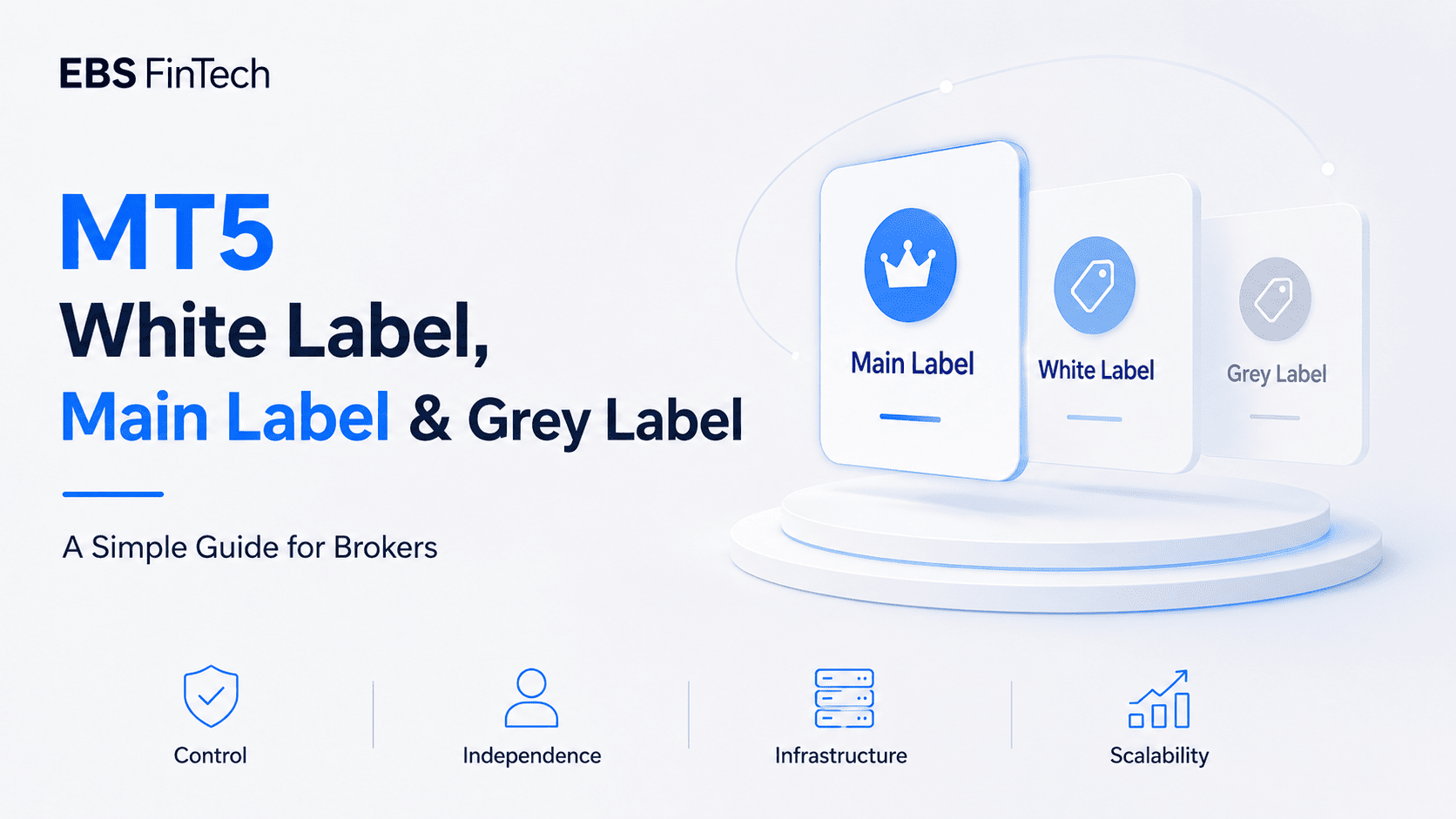
Most people who set out to launch a forex or CFD brokerage hit the same wall within a week: how do you actually get MetaTrader 5 onto a screen with your name on it? You’ll run into three terms — main label, white label and grey label — that get used loosely and often interchangeably. They are not the same thing, and picking the wrong one can lock you into a structure that’s expensive to unwind. Here’s a plain-English walkthrough of what each model is, what it realistically costs, how much control you actually get, and who each one suits.
Start with who owns the platform
MetaTrader 5 is built and owned by MetaQuotes. Nobody runs MT5 without a licensing relationship that traces back, directly or indirectly, to them. The three label models are simply different points on that chain — different distances from the source, with different price tags and different amounts of freedom attached. Picture a hierarchy: MetaQuotes at the top, a full server license holder below them, and the brokers who build on that license below that. The further down you sit, the cheaper and faster it is to get going, and the less you control.
Main label: you hold the keys
A main label, often called a full license, means you license the MT5 server directly from MetaQuotes. You get your own server, full administrator access, and control over symbols, trading groups and leverage. Depending on the license terms and provider structure, a main label operator may also be able to support sub-branded arrangements or white-label style deployments for other brokers.
On cost, treat round numbers with caution. Full MT5 server arrangements are now often structured around monthly license and support fees, with the final figure depending on the license tier, account capacity and the components you need. Whatever the headline, the license is only the entry ticket. Once you add low-latency hosting, a bridge, liquidity, a CRM, KYC/AML tooling and the staff to run it all, a realistic first year budget runs well into five figures and beyond. This route makes sense when you have the capital, the regulatory standing and a long term plan — particularly if you intend to turn infrastructure into a revenue line of its own.
White label: your brand, someone else’s server
A white label is the model most new brokers actually use. You operate under an existing main label holder’s server, but your clients see your brand — your name, your logo, your colours, your server name in the terminal. Behind the scenes, the main label holder or a technology provider keeps the servers running, applies MetaQuotes updates and carries the heavy infrastructure.
Commercially, depending on the agreement, you may manage the client relationship, your pricing, your marketing and the back office for accounts and reporting. How much of the execution model you control — A Book, B Book or a hybrid — and how much back-office access you get will vary with the contract and the upstream provider, so it’s worth pinning that down before you sign. To a trader, a well built white label is hard to tell apart from a broker running its own license.
One detail trips people up. MetaQuotes stopped approving new MT4/MT5 white label arrangements around late 2022. In practice, new brokers generally need to work through existing licensed server holders or technology providers rather than purchasing a new white label directly from MetaQuotes. On cost, setup fees commonly range from several thousand dollars to around USD 15,000 or more, while monthly costs vary widely depending on hosting, bridge, liquidity, CRM, support scope and compliance requirements. A basic white label can look inexpensive on the platform fee alone, but a production ready brokerage environment usually costs more than that headline number. Launch typically takes weeks rather than months.
Grey label: the lightest entry point
A grey label sits in the gap between an introducing broker (IB) arrangement and a full white label. You offer MT5 to your clients, but much closer to the parent broker’s own identity. Branding is minimal or shared, customisation is limited, and clients often operate fairly visibly on the main broker’s platform rather than a fully separate branded one.
In return, it is the cheapest and fastest way in — often live in days, on a fraction of the capital a white label needs. For a small firm, an IB wanting more control over its client relationships, or anyone testing a market before committing real money, it’s a sensible low risk start. As with white labels, a grey label is set up under an existing license holder, so the same point applies: you’re building on someone else’s permissions, not minting a new license of your own.
The honest tradeoff is dependence and ceiling. You operate closely under someone else’s brand and rules, your room to differentiate is narrow, and a growing business will likely outgrow the model and need to migrate up. Plenty of brokers do exactly that — start grey, prove the model, then upgrade — but it’s worth going in with that path in mind.
| Main Label (Full License) | White Label | Grey Label | |
|---|---|---|---|
| Relationship to MetaQuotes | Direct license | Under an existing main-label holder | Under a main-label holder, lighter |
| Branding | Full | Full (your own brand) | Minimal / shared |
| Server control | Full admin access | None (provider-managed) | None |
| Client relationship | Yours | Largely yours, depending on the agreement | Mostly the parent’s; less separation |
| Indicative cost | No public MetaQuotes price; typically monthly license + support, plus hosting, bridge, liquidity and staff | Setup ~several thousand to USD 15k+; monthly varies with components | Lowest entry cost; often well below a white label |
| Time to launch | Months (weeks with a managed partner) | Weeks | Days |
| Best for | Established, well-capitalised brokers; infrastructure providers | New-to-growth brokers wanting their own brand | Startups, IBs, market testing |
So which one should you pick?
The mistake to avoid is choosing the structure first and fitting your business to it. Work the other way round. Testing whether demand exists at all? A grey label keeps your risk small. Committed to a real, branded brokerage but don’t want to own and run server infrastructure? A white label is the natural home for most firms. Have the capital, the regulatory footing and the ambition to control everything? A main label is worth the weight it carries.
A good technology partner matters more than the label itself. The cleanest setups come from working with an independent provider who runs the infrastructure but lets you connect your own liquidity and payment partners, so you keep the flexibility to grow without being tied to a single counterparty for both technology and pricing.
That’s where EBS FinTech focuses. We help brokers stand up MT5 across all three models — white label, grey label and full main label deployments — with the bridge, liquidity integration, hosting and backoffice plumbing that turns a bare server into a working business. If you’re weighing which route fits your stage, get in touch and we’ll talk it through.
This article is for general educational purposes and does not constitute legal, financial or regulatory advice. Licensing terms and pricing change; confirm current details for your jurisdiction before committing.
MetaTrader 5 and MT5 are trademarks or registered trademarks of MetaQuotes Ltd. EBS FinTech is an independent technology service provider and is not affiliated with, endorsed by, or acting on behalf of MetaQuotes.