MT5 is now the default platform across most of the FX and CFD industry — which means owning it is no longer an edge, because almost everyone has it. The questions that actually separate brokers in 2026 are different: where the server sits, how orders are routed, what execution quality clients receive, and who keeps the whole thing running at 3 a.m. when a liquidity feed drops.
The platform is the easy part. The infrastructure behind it is where brokers win or lose.
Why MT5 on Its Own Falls Short
MT5 is a capable multi asset platform, but it doesn’t make operational decisions for you. Server location, client connectivity, liquidity selection, bridge routing logic, risk monitoring, backup design, and day to day maintenance all sit outside the box.
New brokers tend to spend their energy “getting MT5” and treat everything else as an afterthought. The result is predictable: latency spikes, a single fragile liquidity feed, execution complaints, and no one on call when something breaks. The broker with stronger infrastructure simply runs a more stable business — regardless of who has the flashier front end.
The Five Components That Actually Matter
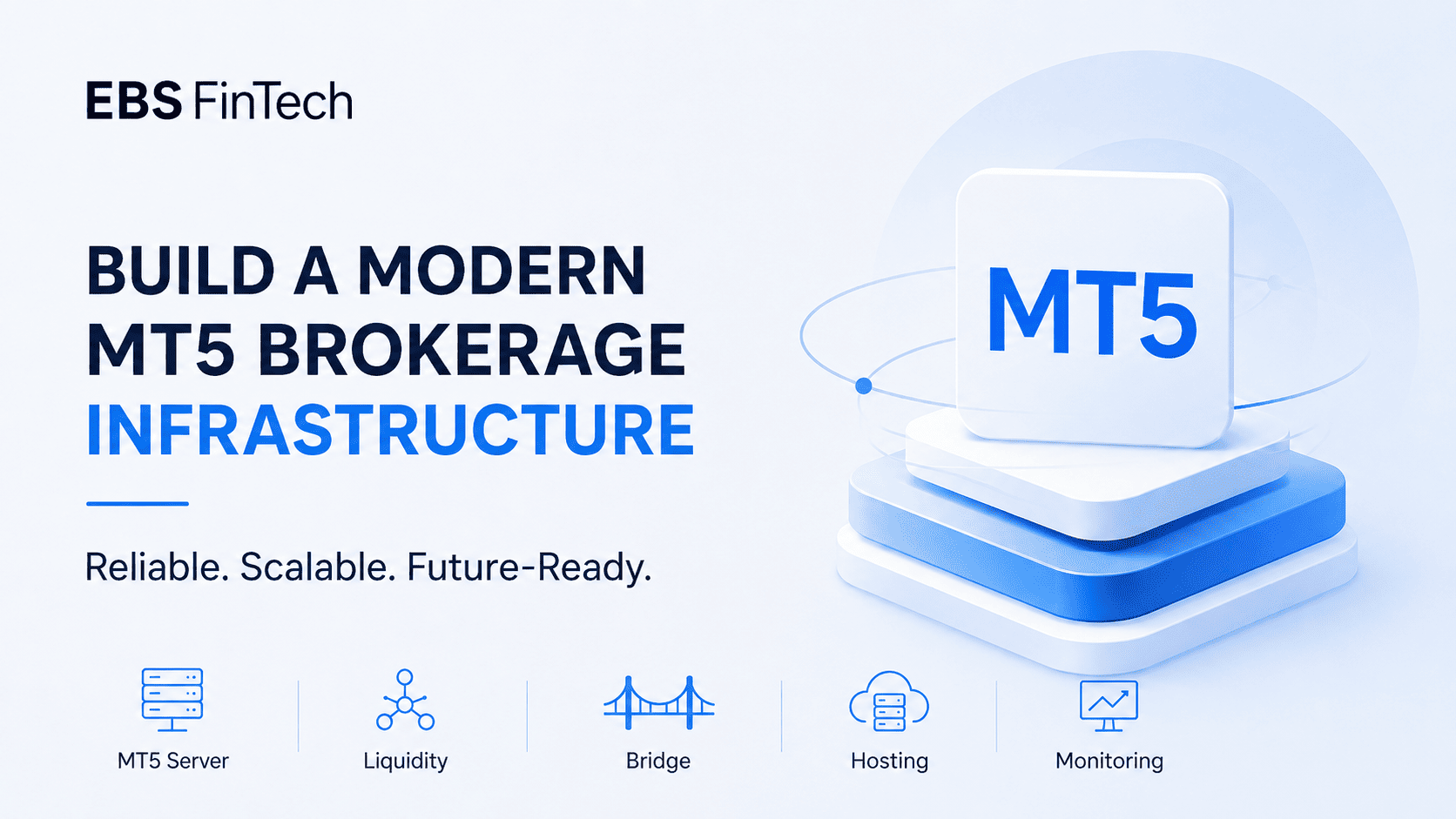
A modern MT5 setup rests on five pieces: the MT5 server, liquidity, the bridge, hosting, and monitoring. None of them works in isolation. Excellent liquidity won’t save you from poor hosting; a sophisticated bridge is useless on an unstable server; and without monitoring, you find out about problems from angry clients instead of dashboards.
1. MT5 Server
This is the operating system of your business. It handles accounts, symbols, groups, permissions, pricing, order processing, reporting, and administration. A full environment typically runs a Trade Server, Access Server, and Backup Server, plus Administrator and Manager terminals.
The configuration here isn’t cosmetic. Leverage, margin rules, swaps, client grouping, execution logic, and risk controls all live at this layer, and a mistake in the initial setup tends to resurface later as a financial or compliance problem. It pays to get it right once.
2. Liquidity
Liquidity defines what your clients actually trade against. Depending on volume and client profile, you might use a single provider, a Prime of Prime, or a multi LP structure.
Single LP setups are easy to launch — and tempting for exactly that reason — but they create a single point of failure. If pricing degrades or the connection drops, you have nowhere to route. When evaluating providers, the factors that matter are spread quality, depth of market, execution speed, rejection and slippage rates, instrument coverage, regional reach, and credit terms. Brokers with real growth ambitions usually move toward multi LP, because it buys flexibility in pricing, routing, and risk.
3. Bridge
The bridge stopped being a simple connector years ago. Today it sits in the execution and risk layer: price aggregation, order routing, A-book and B-book handling, hybrid models, markups, symbol mapping, and liquidity allocation all run through it.
A well configured bridge lets you aggregate prices across LPs, route orders by symbol, group, volume, or client type, manage A-book/B-book exposure deliberately, and reduce reliance on any single feed. That makes bridge selection a strategic decision, not a line item. The right question isn’t “what’s the monthly fee” — it’s “does this bridge support my execution model, risk policy, and the structure I want two years from now.”
4. Hosting
Hosting is the component new brokers most often underestimate. A cheap VPS looks attractive on day one, but trading infrastructure has different demands: stability, security, low latency, and someone to maintain it. The first disconnection during a volatile session — and the client complaints that follow — usually costs more than the hosting you saved.
For broker grade hosting, weigh data center location, latency to your LPs, raw server performance, network stability, DDoS protection, backup environment, access control, and support response times. Financial-grade venues like LD4, NY4, and Hong Kong show up repeatedly in low-latency broker designs for a reason: the trading server should sit as close to liquidity and execution as you can put it.
5. Monitoring
You can’t manage what you don’t measure. Modern MT5 infrastructure needs continuous monitoring at two levels — the server (CPU, memory, disk, latency, uptime, access and bridge status, LP connections, backups) and execution (order speed, rejection rate, slippage, abnormal activity).
Server only monitoring tells you the machine is alive; execution monitoring tells you whether clients are getting a fair fill. Done well, it surfaces problems before they reach a client and gives management an honest view of execution quality and operational risk.
Four Mistakes That Show Up Later
Most infrastructure problems trace back to a handful of early decisions.
Relying on one LP. Fine at launch, dangerous as you scale. Even if you start with a single provider, design the architecture so a second one can be added without rebuilding.
Skipping backup and disaster recovery. Many brokers only take this seriously after their first outage. By then it’s already a trust problem with clients, not just a technical one. Backup servers, access redundancy, and recovery procedures belong in the initial design.
Treating hosting as a price comparison. A budget VPS is fine for personal trading and wrong for a brokerage. Stable connectivity, real server resources, security, and monitoring aren’t optional at this layer.
No dedicated maintenance. MT5 is not set and forget. Server upkeep, plugin updates, bridge issues, LP connection checks, symbol and group changes, log review, and emergency troubleshooting are ongoing work. Without it, small issues compound.
A Structure Built to Scale
A practical modern stack looks like this:
MT5 Server → Bridge → Multi-LP Liquidity → Professional Hosting → Continuous Monitoring
The point of separating the layers is flexibility. Start with one LP and add more later. Begin on standard hosting and migrate closer to key venues as you grow. Strengthen monitoring and execution analytics as volume rises. The discipline is to design for expansion from day one rather than bolting systems together under pressure.
From Platform Setup to Infrastructure Design
The industry has moved from “platform setup” to “infrastructure design.” Having MT5 used to be a differentiator; now it’s table stakes. The real difference shows up in execution quality, liquidity structure, server reliability, bridge logic, and how fast technical issues get resolved.
So when planning an MT5 project, the better question isn’t “how much does setup cost?” It’s “what infrastructure do we need to support stable execution, future growth, and lower operational risk?”
How EBS FinTech Helps
EBS FinTech builds, runs and upgrades MT5 infrastructure for brokers — covering MT5 white label setup, MT4/MT5 hosting and maintenance, server hosting, LP integration, bridge integration, broker infrastructure consulting, and ongoing technical support.
Whether you’re standing up a new MT5 brokerage or upgrading an existing environment, we can handle server deployment, bridge configuration, liquidity connectivity, hosting planning and long term operations. A modern broker needs more than a trading platform; it needs infrastructure that carries execution, liquidity, risk control and growth.
In 2026, MT5 is still one of the most important platforms in FX and CFD — but the platform alone is no longer the answer. For brokers entering the market or upgrading their setup, the priority is clear: don’t build MT5 as a standalone platform; design it as one part of a complete brokerage infrastructure.