- What Is an MT5 Backup Server?
- Backup Server vs Access Server vs Disaster Recovery
- What Data Should Be Protected?
- Replication, Recovery Points and Standby Models
- Will an MT5 Backup Server Fail Over Automatically?
- RPO, RTO and Geographic Separation
- Bridge, LP and Network Dependencies
- Security and Independent Backup Copies
- Restore Testing and Reconciliation
- MT5 Backup Checklist
- How EBS FinTech Supports Brokers
Ask whether an MT5 environment has a backup server and the answer is usually yes. Ask what it protects, when it last synchronised, and whether anyone has restored from it, and the answers get vaguer.
The vague part is where an outage becomes expensive. A second machine covers some hardware failures. It does nothing about a configuration mistake that replicates cleanly to the standby, and it does not help when the recovery server boots but its liquidity session never comes up.
A backup server needs a defined job: what it holds, how current it stays, which failures it covers, and what has to be checked before trading resumes.
What Is an MT5 Backup Server?
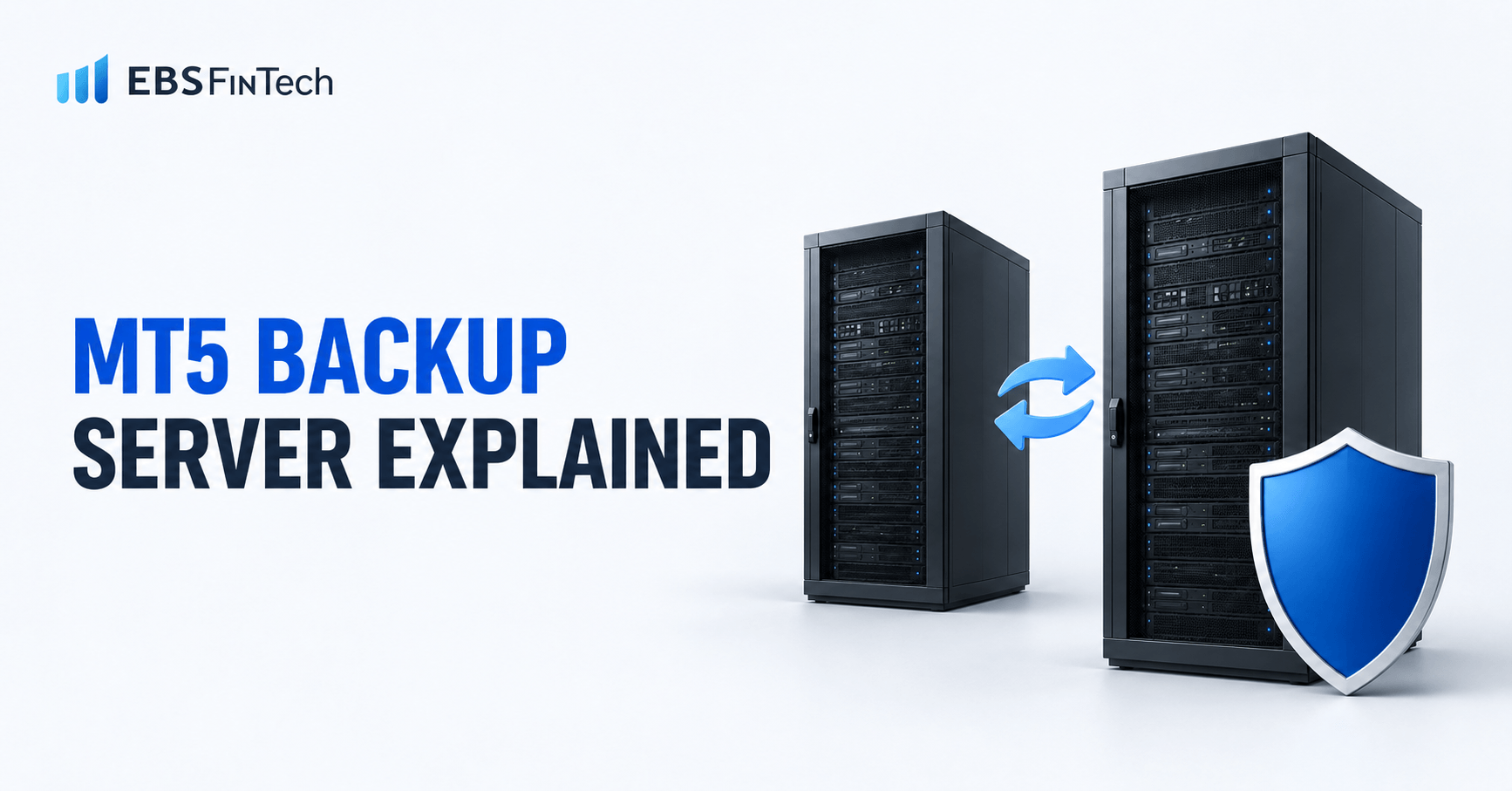
In broker infrastructure, an MT5 backup server means a server running the platform’s backup components, maintaining a recoverable copy of platform data within the deployed architecture.
The phrase gets used loosely. Some vendors mean a spare machine, others mean a file store holding backup archives. Those are different capabilities, so a proposal should say which one it delivers.
MetaQuotes identifies access, trade, history and backup servers as distinct components within the MetaTrader 5 infrastructure. Confirm which of them your arrangement covers and how each is recovered, rather than assuming one spare Windows box covers the platform.
This article is about broker side infrastructure, not about backing up a trader’s terminal, indicators or Expert Advisors.
Backup Server vs Access Server vs Disaster Recovery
| Component or approach | Main purpose | Common misreading |
|---|---|---|
| Access server | Provides client connection paths into the trading infrastructure | That extra access points restore a failed trade server |
| MT5 backup server | Maintains a recoverable platform state and, depending on configuration, supports redundancy and recovery within its scope | That every connected business system is covered |
| Independent backup archive | Preserves earlier recoverable versions of data and configuration | That a running replacement environment already exists |
| High availability | Reduces interruption through redundancy and failure handling | That corruption or a site outage is covered |
| Disaster recovery | Restores an agreed level of operating capability after a major disruption | That service never stops |
MetaQuotes describes a distributed design in which trade servers sit behind multiple access points. Client access and core trade processing are separate layers, so adding access points does not replace a failed trade server, and their effect on latency depends on routing and location.
This article stays on the backup environment itself. Site level incidents, escalation, client communication and full recovery exercises belong to our MT5 disaster recovery guide.
What Data Should Be Protected?
Hardware failure is one cause of data loss among several. Disk corruption, operating system faults, accidental deletion, a wrong setting, a failed update and ransomware can all leave production data unusable or untrustworthy.
| Area | Data and configuration to include |
|---|---|
| Accounts and trading records | Accounts, orders, deals, positions, balance and credit operations, trading history |
| Trading configuration | Groups, symbols, sessions, contract specifications, margin settings, swaps and commissions |
| Staff access | Administrator, manager and dealer permissions, including account and group scope |
| Platform operation | Server settings, required platform components, plugin configuration, compatible software versions |
| History and evidence | Required price history, reports, operational logs, audit records |
| Execution connections | Bridge or gateway settings, FIX configuration, symbol mapping, routing, risk controls |
| Business systems | CRM records, client portal data, payment references, integration state |
| Recovery infrastructure | Network configuration, monitoring, certificates, recovery documentation, secure access arrangements |
That table is a scope inventory, not a claim that the backup server captures all of it automatically. Bridge databases, CRM records and payment workflows usually need their own protection. For a hosted third party service, establish what the provider backs up, what you can export, and how a recovery request is raised.
Use the backup, replication and export methods the relevant software supports. Copying files out of a running system, or taking a generic virtual machine snapshot, does not on its own produce data you can rely on restoring.
Credentials need separate handling. API keys, FIX passwords and certificate private keys belong in controlled secret storage, not in an ordinary configuration document.
Replication, Recovery Points and Standby Models
Replication keeps a recovery copy close to the current production state. Scheduled backups preserve earlier recovery points. Both matter, because replication carries mistakes as faithfully as it carries good data: an administrator applies a wrong setting and the standby has it before anyone notices.
Take an illustrative case. The only backup runs at midnight and production storage fails at 16:00. With no newer recoverable records, the gap can hold up to sixteen hours of activity. That the job completed successfully says nothing about whether that recovery point is acceptable for a live trading business.
Frequency should follow the impact of losing each dataset. Core trading records and account state need continuous replication, or another mechanism able to meet the agreed RPO, with retained recovery points alongside. Groups, symbols, routing and permissions need controlled versions around material changes. Logs deserve more than a daily job, because losing the records from immediately before an incident makes order investigation and reconciliation much harder.
Hot, warm and cold are general infrastructure terms, not official MT5 modes, and vendors apply them inconsistently.
| Arrangement | Typical preparation | Main recovery consideration |
|---|---|---|
| Hot standby | A running environment with current data and most dependencies prepared | Validating state and transferring service safely |
| Warm standby | Partly prepared, may need additional services, capacity or configuration | Finishing preparation before it accepts production traffic |
| Cold recovery | Backup data and installation material exist, environment must be started or rebuilt | Provisioning, restoration and integration all take time |
A warm environment can still replicate continuously. A hot environment can still require manual approval before it takes over. Readiness, replication frequency and automation are three separate decisions, and the tradeoff behind all of them is running cost against work left to do during an incident. AWS sets out that relationship clearly, though its patterns are not MT5 deployment instructions.
Monitor replication lag and the age of the newest usable backup, not just whether a scheduled job ran.
Will an MT5 Backup Server Fail Over Automatically?
Automatic failover can be built into a properly configured deployment. It cannot be inferred from a server named “backup”. Verify:
- Which failures trigger takeover.
- Whether the standby data is current enough and in a usable state.
- How client connections reach the replacement service.
- How bridge, gateway and LP sessions behave.
- How the former primary is stopped from processing conflicting activity.
- Who authorises recovery when the primary data may be corrupt.
RPO, RTO and Geographic Separation
Recovery point objective defines the point in time before a disruption to which data must be recoverable. In practice it expresses the maximum tolerable data loss window. Recovery time objective is the target period within which a system or function must be restored. Both definitions come from NIST SP 800-34.
An RPO of one minute is a design target, not evidence that every failure will cost less than a minute of records. An RTO of 30 minutes is incomplete until the milestone is defined: Windows started, clients able to log in, or trading approved to resume with the necessary checks done. Record technical restoration and business validation separately.
Core trading functions will usually justify tighter recovery objectives than a marketing website. Agree the numbers before selecting hardware and hosting.
Separation is the other half of the same decision. A second server in the same facility covers some single machine failures and stays exposed to anything that takes the facility out. Check each level: physical host and storage, rack and power, network equipment and upstream links, data centre, city or region, and the administrative accounts above all of it. Two virtual machines on one host, or two sites behind one compromised administrator account, can be lost together. If the recovery objective covers loss of the primary data centre, usable capability has to exist outside it, and the standby has to absorb reconnecting clients, pricing traffic and the trading load you intend to carry.
Bridge, LP and Network Dependencies
Restoring an operating system does not restore the network relationships around it. The recovery inventory should include DNS, published client endpoints, firewall rules, IP routing, VPN access, certificates and provider allowlists. Changing DNS will not move every client at once, because cached records and application connection behaviour still apply.
For external execution, verify approved recovery IP addresses and endpoints, valid LP credentials and session permissions, FIX session recovery procedures agreed with the provider, bridge or gateway compatibility and licensing, symbol and account mapping, routing rules, markups and risk limits, and the handling of outstanding requests so nothing is submitted twice. A restored price feed says nothing about whether orders can be executed or hedged.
CRM and client portal need defined recovery boundaries too. Running existing trading while onboarding or deposits are unavailable can be a reasonable interim state, but agree it in advance, with controls and reconciliation to match. Payment providers and KYC vendors are usually not systems a broker can back up: protect your own records and confirm what the provider restores.
Security and Independent Backup Copies
A replica reachable with the same credentials as production can be deleted or encrypted in the same attack.
Keep independent recovery copies with a defined retention period. At least one should be protected against alteration or deletion from the production environment. Properly configured immutable storage restricts or prevents alteration and deletion during the defined retention period; offline storage is disconnected from ordinary online access. CISA recommends offline, encrypted backups and regular recovery testing in its #StopRansomware Guide.
Supporting controls include restricted administrator and vendor access, encryption, audit logging, and MFA on management systems that support it. Recovery access and decryption keys must remain available if the production identity service is down. Standby servers need maintenance too, so put patches and platform compatibility under change control.
Restore Testing and Reconciliation
A backup job reporting success tells you a process finished. Only a restore test tells you the copy is usable.
Start in an isolated environment. Restore data and configuration, confirm versions and permissions, then inspect account records, trading history, groups and symbols. Run integration tests through approved test connections so the exercise cannot place production orders or repeat payment instructions.
Failover testing answers a different question: when a component or connection fails, does the prepared environment take over? Use scenarios such as trade server loss, site isolation, network failure and unavailable LP sessions, and simulate corruption in a controlled environment. An LP disconnection tests the execution response; it is not by itself a reason to switch the MT5 server.
A workable cadence: monitor failed jobs, replication lag and capacity daily; review configuration changes weekly and after material changes; sample a restore monthly or quarterly; exercise selected failover scenarios each quarter or half year; and retest after major upgrades or new integrations. Our MT5 maintenance checklist covers the routine tasks around these.
After recovery, reconcile the affected period: orders, deals and positions; balance and credit operations; swaps and commissions; bridge records against LP confirmations; CRM and payment records. Pay particular attention to requests sent just before the interruption that received no response, because a missing acknowledgement is not proof that nothing was executed. Test the return to the primary environment as well, so activity accumulated during recovery is not overwritten.
MT5 Backup Checklist
- The protected MT5 components and datasets are documented.
- Accounts, orders, deals, positions and required history are recoverable.
- Groups, symbols, permissions and server configuration are included.
- Replication lag and backup age are monitored.
- Independent historical recovery points are retained, at least one beyond production’s reach.
- The recovery environment has adequate capacity and separation.
- Bridge, gateway and LP recovery requirements are verified.
- CRM, portal and payment responsibilities are documented.
- Network settings, credentials and certificates are recoverable, and stay accessible during an incident.
- A restore, an applicable failover scenario, and the failback path have been tested.
The gaps are usually mundane: an expired credential, a stale routing rule, an unpatched standby, or a recovery procedure only one administrator knows.
How EBS FinTech Supports Brokers
EBS FinTech reviews backup requirements as part of server hosting and MT4 and MT5 maintenance. Depending on the environment and agreed scope, that covers server deployment, backup planning, monitoring, configuration protection, access server deployment, recovery procedures, restore testing and incident investigation. Bridge and LP connectivity problems are investigated and coordinated with the responsible provider where needed.
To review your current setup, send your server locations, connected systems and latest restore test results through the EBS FinTech contact form.